The AI Earnings Reality Check:
Can Big Tech Keep the Rally Alive?
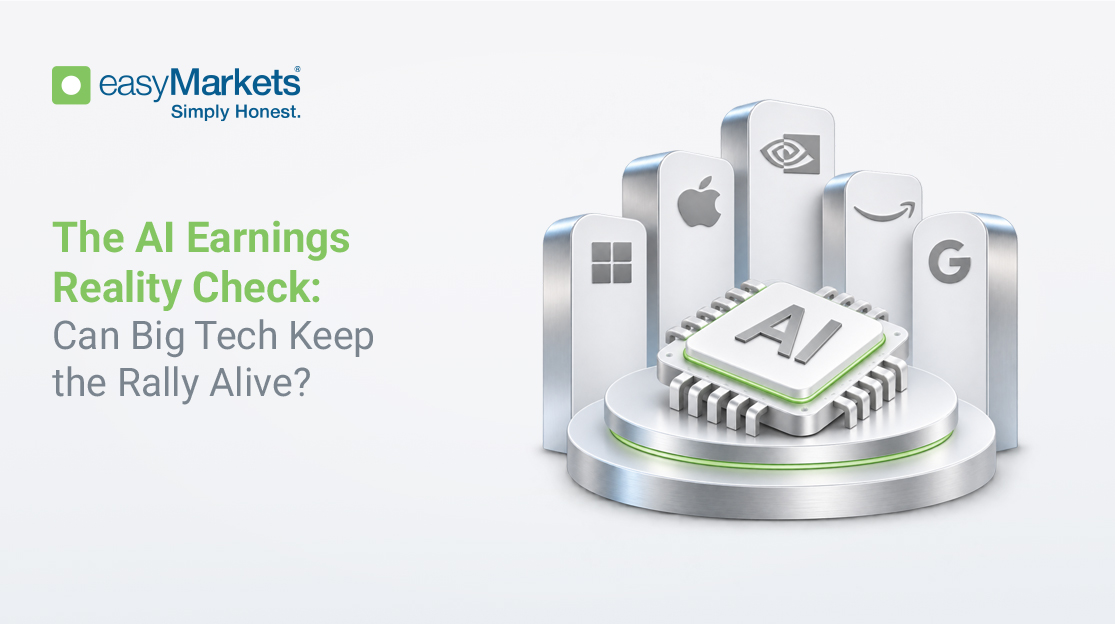
Artificial intelligence has become one of the biggest drivers of investor interest in the stock market. From powerful computer chips to cloud computing and AI-powered software, technology companies are investing heavily to secure their place in what could become one of the most important technological shifts in years.
But as spending continues to grow, investors are asking a more difficult question: are these companies actually making enough money from AI to justify their investments?
For a while, the excitement surrounding AI has helped support technology stocks. Now, the focus is shifting towards earnings, profitability and whether the businesses behind the AI boom can deliver on market expectations.
The latest earnings reports are providing some important clues, but the picture is not the same for every company. For traders, the results could influence the Nasdaq, individual technology stocks, semiconductor manufacturers and the wider US stock market. They may also have implications for the US dollar as investors reassess the outlook for the American economy.
Are AI companies turning investment into real revenue?
There is certainly no shortage of investment in artificial intelligence. Microsoft, Alphabet, Amazon and Meta are spending heavily on data centres, computing infrastructure and AI development. Meanwhile, companies such as Nvidia and Broadcom are supplying the technology needed to power these systems.
The commercial opportunity is clear. AI can help businesses develop new products, improve existing services and operate more efficiently. Cloud providers can offer new AI services, while software companies can introduce features that customers may be willing to pay for.
The challenge is turning that potential into sustainable profits.
Building and operating AI infrastructure is expensive. Companies need computing equipment, data centres, electricity and skilled employees to develop and maintain their technology. The financial benefits may take time to catch up with the investment. Meta's latest earnings provide a useful example. The company reported strong revenue growth, supported by its advertising business and expanding AI capabilities, while also highlighting the enormous cost of continuing its AI investment programme. Its results show why investors need to look beyond revenue alone when assessing the health of a business.
A company can attract more customers and generate additional revenue without immediately seeing the same improvement in profitability or cash flow.
Our view is that investors are becoming more selective. The question is no longer simply which companies are investing in AI, but which businesses can demonstrate that their investments are creating lasting commercial value.
Can Big Tech earnings justify current valuations?
Strong earnings do not automatically mean a stock is attractively priced.
A company can be growing, developing promising products and delivering solid financial results, yet its share price may already reflect very optimistic expectations about the future.
This is particularly relevant to major technology companies, where excitement surrounding AI has played an important role in investor sentiment.
During earnings season, investors will be looking at revenue growth, profit margins, cloud demand and management's outlook for future spending. They will also want to know whether new AI services are attracting paying customers and contributing meaningfully to the bottom line.
Imagine a company reporting stronger sales but announcing that it needs to spend considerably more to support its growth. Investors may welcome the increase in demand while questioning whether the additional investment will eventually translate into higher profits.
By contrast, a company that demonstrates strong demand, healthy margins and a clear path towards generating revenue from AI could attract further investor interest.
This is why market expectations matter so much. Share prices do not respond only to whether a company delivers good results. They also respond to whether those results are better or worse than investors anticipated.
A company can beat earnings expectations and still experience selling pressure if its future outlook disappoints. Equally, a less impressive report may receive a positive response if investors were already expecting weaker results.
What happens if AI spending starts to slow?
Another important question is what would happen if major technology companies began slowing their AI investments.
At first, this might not be a bad thing. Companies could become more disciplined with their spending, focus on improving existing infrastructure and generate better returns from projects already underway.
However, the reason for the slowdown would be crucial.
If businesses are spending more carefully because they want to improve efficiency, investors could welcome the change. Lower investment costs, combined with continued demand for AI services, could support better cash flow and profitability.
But if spending slows because customers are not adopting AI as quickly as expected, the reaction could be very different.
Companies supplying the infrastructure behind the AI boom could face weaker demand. Semiconductor manufacturers, server producers and data centre operators all depend, to varying degrees, on continued investment from major technology companies.
A sustained reduction in orders could put pressure on their earnings outlook and lead investors to reconsider the valuations of these businesses.
The consequences would not necessarily be limited to infrastructure suppliers. If investors began questioning the profitability of AI investments more broadly, confidence across the wider technology sector could weaken.
The important distinction is whether companies are becoming more efficient or whether demand is falling short of expectations. These scenarios may look similar at first, but their implications for the market are very different.
How could earnings affect the Nasdaq and other technology stocks?
The Nasdaq is an important market to watch because of its exposure to technology and growth-oriented businesses. However, the wider technology sector deserves just as much attention as the index itself.
Microsoft, Alphabet, Amazon and Meta offer insight into cloud computing, advertising and the commercial adoption of AI. Nvidia and Broadcom provide a view of demand for semiconductors, while companies such as Dell and Super Micro Computer help reveal how much demand exists for AI servers and data centre equipment.
These businesses are connected, but their share prices will not necessarily move in the same direction.
Strong cloud revenue could support a company's shares if investors believe demand will continue to grow. Semiconductor manufacturers may benefit from sustained demand for computing power, while AI infrastructure companies could gain from stronger spending by their customers.
However, even a strong earnings report may fail to support a share price if investors believe the company's future growth is already reflected in its valuation.
Recent trading has shown how quickly sentiment can change. Results from SpaceX and Super Micro Computer helped improve appetite for AI-related stocks, while Netflix faced pressure after its outlook disappointed investors. The contrasting reactions highlight that the technology sector is not moving as one unified group.
For traders, this is an important point. A rising Nasdaq does not necessarily mean every technology stock is participating in the rally.
We should look at whether gains are spreading across different parts of the sector or remaining concentrated in a handful of large companies. Broad participation could signal improving confidence, while a more uneven performance may suggest investors are becoming increasingly selective.
The S&P 500 is also worth monitoring, as it provides a broader view of the US equity market beyond technology alone.
Could stronger earnings support the US dollar?
Although AI earnings are primarily a stock market story, they could also influence the US dollar through their impact on investor confidence and expectations for the US economy.
Stronger results from major American companies may reinforce the view that US businesses remain competitive and economic activity is holding up well. If this contributes to rising Treasury yields or changes expectations around Federal Reserve policy, the dollar could find support.
However, the relationship is not straightforward. Strong technology earnings could encourage investors to take on more risk, potentially reducing demand for the US dollar as a safe-haven asset. At the same time, inflation, employment data, interest rate expectations and geopolitical developments will continue to influence currency markets.
For example, if positive earnings coincide with rising Treasury yields and expectations of tighter monetary policy, the dollar could benefit. If investors instead focus on stronger equity markets and improved risk appetite, the dollar may come under pressure.
Neither outcome is guaranteed.
Our view is that technology earnings should be treated as one part of the wider market picture rather than a standalone signal for the US dollar. The reaction in Treasury yields and currency markets will be just as important as the earnings announcements themselves.
What if market expectations are too high?
This may be the biggest risk facing the AI investment theme.
The opportunity presented by artificial intelligence is significant, but that does not mean every company involved will achieve the growth investors anticipate. Nor does it mean share prices can continue rising without financial results to support them.
When expectations become stretched, even a relatively small disappointment can trigger a sharp market reaction.
Investors may begin questioning whether projected revenue growth is achievable, whether spending will remain manageable and whether the financial benefits of AI will arrive quickly enough to justify current valuations.
Meta's latest results illustrate why it is important to look beyond the headline figures. While its core business continued to grow, rising expenses and substantial investment commitments highlighted the costs involved in pursuing its AI ambitions.
The company also recorded a significant legal charge, which needs to be considered when assessing its reported profitability.
This does not mean the company's AI strategy will fail. It means investors must weigh the potential rewards against the financial commitments required to achieve them.
If companies continue to deliver strong results and demonstrate that their investments are paying off, the technology rally could retain its momentum. If earnings fail to meet expectations, we could see investors reassess valuations across individual technology stocks and the wider market.
The reaction may be particularly sharp among companies whose share prices depend heavily on expectations of future growth.
Our mar ket view
The AI story is far from over, but the focus is changing. Investors are moving beyond the excitement surrounding new technology and paying closer attention to the financial results behind it.
For the Nasdaq and other technology stocks, the next phase of the rally will depend on whether earnings growth can support current expectations. Revenue, profit margins, capital expenditure and management guidance will all be important.
Semiconductor manufacturers, cloud providers and AI infrastructure companies deserve particular attention because their results can help reveal where demand is strongest and whether investment is translating into sustainable business growth.
We should also keep the wider market in view. The performance of the S&P 500, movements in US Treasury yields and changing expectations for Federal Reserve policy could all influence how investors respond to earnings and how these developments feed into the US dollar.
Our view is that the market is likely to become more selective as investors distinguish between companies demonstrating measurable returns and those still relying heavily on future growth expectations.
For traders, this means looking beyond the initial headline reaction. A company can report encouraging earnings and still see its shares fall if its outlook disappoints. Similarly, a weaker report may already be reflected in the share price.
The key is to assess the results, understand what the market expected beforehand and watch how prices respond. Earnings announcements can create opportunities, but they can also bring sharp and unpredictable movements, making risk management essential.
The bottom line: Artificial intelligence remains a major growth opportunity, but investors are asking tougher questions about profitability, valuations and returns on investment. Whether the Nasdaq and the wider technology sector can maintain their momentum will depend on what companies deliver, not just what they promise.
The market is no longer asking only how big AI could become. It is asking how much money these companies can actually make from it.
Artificial intelligence has become one of the biggest drivers of investor interest in the stock market. From powerful computer chips to cloud computing and AI-powered software, technology companies are investing heavily to secure their place in what could become one of the most important technological shifts in years.
But as spending continues to grow, investors are asking a more difficult question: are these companies actually making enough money from AI to justify their investments?
For a while, the excitement surrounding AI has helped support technology stocks. Now, the focus is shifting towards earnings, profitability and whether the businesses behind the AI boom can deliver on market expectations.
The latest earnings reports are providing some important clues, but the picture is not the same for every company. For traders, the results could influence the Nasdaq, individual technology stocks, semiconductor manufacturers and the wider US stock market. They may also have implications for the US dollar as investors reassess the outlook for the American economy.